
You open the door, look at your dog, and the first thing you check is the haircut. Everybody does. Is it even, is the face right, is it shorter than you wanted.
We're looking somewhere else. The first thing a groomer does with a dog is lift an ear.
Why do ears come first?
Because ears go wrong quietly, and because Dallas is humid enough to make them a year round problem.
A dog with a floppy ear, and that's most doodles, spaniels, retrievers and hounds, has a warm dark canal with almost no airflow in it. Add a swim, a bath, a rainy week or a dog who sweats it out in the yard in August, and you have the conditions yeast likes. It doesn't hurt on day one. It itches. The dog scratches, the ear gets more inflamed, and by the time you notice a smell it has been building for weeks.
Every bath here includes an ear cleaning, so your groomer is looking straight into both ears more often than anyone else in your dog's life. Redness, discharge, an odd smell, or a dog who pulls away when one specific ear is touched. All of that goes on the card.
We don't tell you what it is. We're not vets. The wording is always that we noticed something and you should ask your vet about it.
What does a long nail actually do to a dog?
This is the one owners underrate most, and it's the one that hurts old dogs first.
When a nail gets long, the dog can't put their foot down flat. The nail hits the floor before the pad does, so the toe rocks back. Do that for months and the dog changes how they stand. Weight shifts off the front, the wrists take a different angle, and a dog who already has stiff hips is now compensating twice over. On hardwood, which most of Dallas has, they also lose their grip and start splaying out, and a dog who slips once gets nervous about floors.
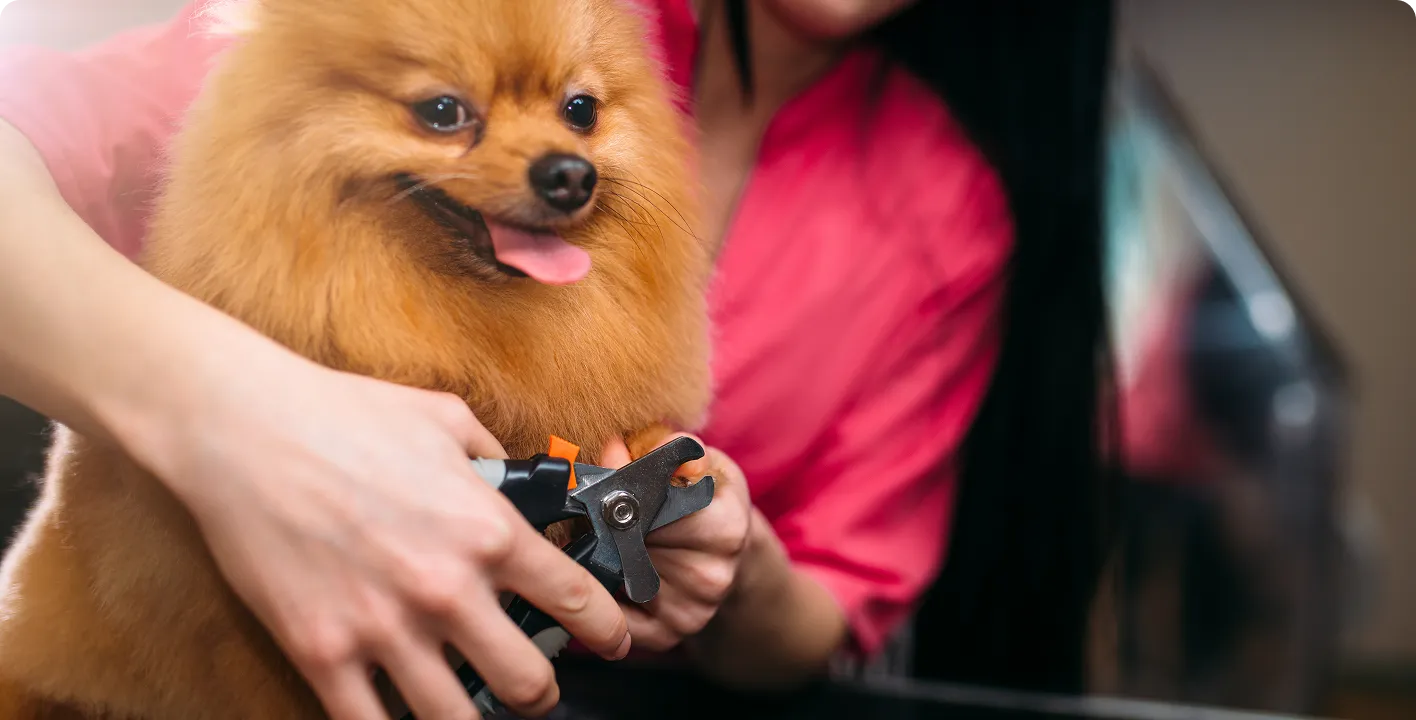
There's a second problem. The quick, the living part inside the nail, grows out along with the nail. Let it go long enough and you can't cut back to a good length in one go, because the quick is now down there. It takes several trims a few weeks apart, taking a little each time so the quick recedes.
That's why a nail trim is in every bath, not an extra. Regular short trims keep the quick where it should be.
Do I really need to worry about teeth?
Yes, and tartar is sneaky because it arrives slowly.
You look at your dog's mouth every day, which is exactly why you can't see it. It builds a little at a time. Someone who looks into a lot of mouths in a month spots it in two seconds, along with a receding gum line, a broken tooth, or breath that has genuinely changed since the last visit.
We're not doing dental work. No scaling, no extractions, no anesthesia, none of that belongs anywhere near a grooming van. What we can do is look, write down what we saw, and tell you it's worth raising at your next vet appointment. Small breeds especially, because a mouth that size crowds teeth together and holds everything against the gum.
Why does all this matter more for an old dog?
Because the margin gets thin.
An ear infection is unpleasant for a young dog. For an old dog whose hearing is already going, it's a much bigger deal. Long nails on a young dog are a bad habit. Long nails on an arthritic dog are the difference between getting up off the tile and not bothering.
Old dogs also hide things. They're stoic in a way that's genuinely inconvenient. A senior dog with a sore paw will limp for one step, then walk normally because you're watching. Hands find it. Eyes don't.
That's a lot of what a visit to a house in North Dallas or Preston Hollow is for a senior dog. Less about the haircut, more about the once over.
Sound like your dog? We bring the van to your driveway. No cages, no car rides, same groomer every time.
BOOK A GROOMWhat can I do between visits?
Not much, and that's fine. But two small things help.
Touch the feet. Not to trim anything, just handle the paws while your dog is half asleep on the sofa. Dogs who hate their feet touched almost always learned it during a bad trim, and the fix is repetition when nothing is happening.
Have a look in the ears once a week. You're not cleaning, you're just seeing. You want pale, dry and no smell. If it looks wet, red or smells sweet or sour, that's a vet call rather than something to wait out until the next groom.
What happens if we find something?
It goes on the report card, in plain words, with where we found it. Ears, eyes, teeth, nails, skin and coat, every visit, written down so it's still there when you get to the kitchen and again when you sit in the vet's waiting room. That's the whole point of the card.
And then you decide what to do about it, which is how it should be. We're the ones with our hands on your dog for an hour every few weeks. That's worth something, and it's worth more when it doesn't evaporate at the front door.