

Your dog came out of the water grinning. Twelve hours later the coat smells like a pond, and your fingers won't go through the fur behind his ears.
That is the whole story of swimming season here. The swim is the easy part. What the water leaves behind is the part nobody plans for.
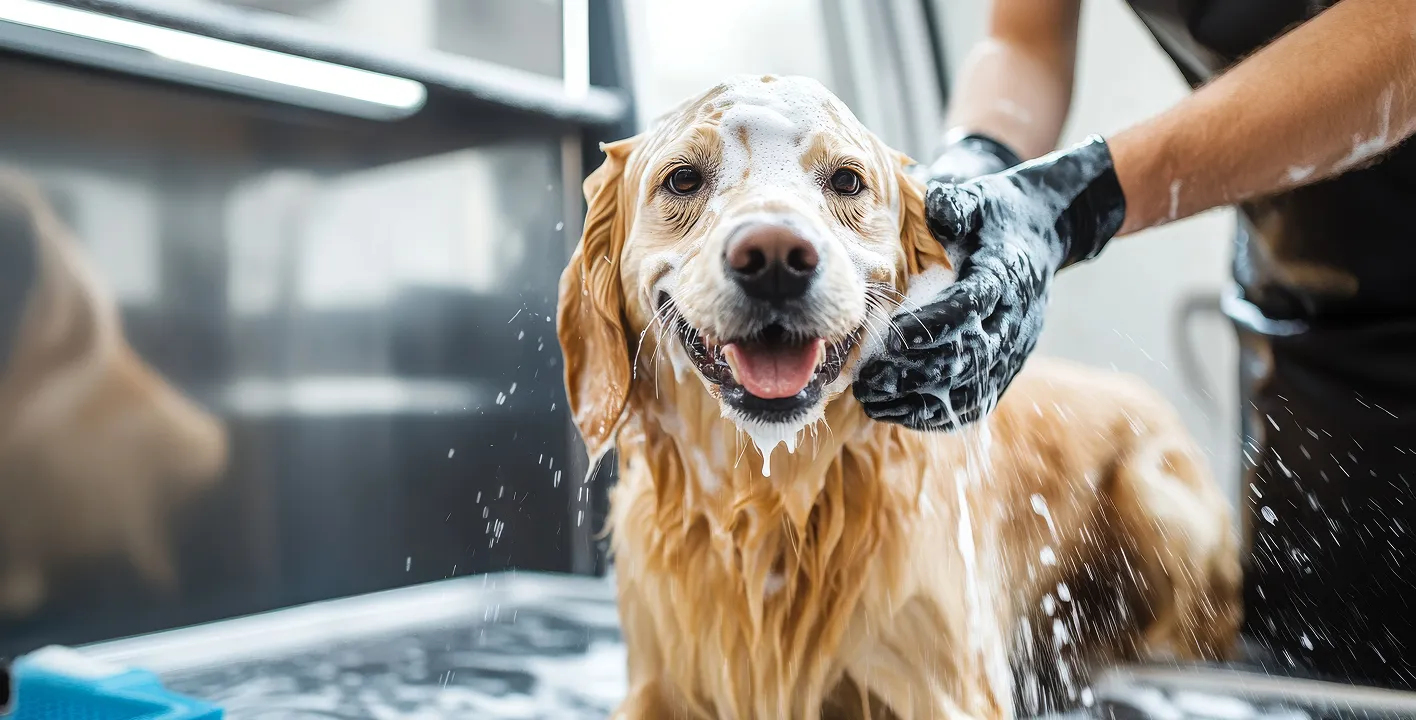
Where do Dallas dogs actually get in the water?
Most of it happens in four places. There's White Rock Lake, where dogs wade in off the shoreline on the Lakewood and East Dallas side. There's Cedar Hill State Park down on Joe Pool, where the ground shelves in slowly. There are the creek crossings out in the Trinity Forest, shallow and muddy and irresistible to a Lab. And there are backyard pools, which in July do more damage to coats on our route than the lake ever does.
Two honest notes. Rules for dogs in the water are not the same at a city park, a state park and a private pool, and they change, so check what's posted the day you go rather than what a neighbor told you last year. And the lake is not the Gulf. It's fresh, warm and shallow, and in late summer it can bloom. If the water looks like paint or smells sharp, keep him out of it.
What does lake water actually do to a coat?
Silt. That's the honest answer. Lake water carries fine sediment, and a wet coat filters it like a screen. The topcoat rinses clean in the driveway and looks fine. The undercoat keeps the grit.
Then it dries. Grit plus a drying undercoat is how a mat starts, and it starts at the friction points first. Behind the ears. The armpits. The britches on the back legs. The tail feathering on a golden. You won't see any of it, because the surface still looks good. You'll feel it a few days later when the brush stops halfway down.
Double coats are worst for this, because there's simply more coat to trap it. Curly coats are second, because curl holds anything it catches. We wrote the timeline out separately in Dog Swam at White Rock Lake? The 48 Hour Rule.
Is pool water any easier on a dog?
Cleaner, yes. Kinder, no.
Chlorine strips oil, and a coat depends on that oil to lie flat and stay flexible. Strip it two or three times a week all summer and you get a coat that feels dry and slightly crunchy, skin that flakes along the spine, and on light dogs a faint green or rust cast in the ears and around the muzzle. A cold rinse right after the swim fixes most of that. Almost nobody does it, because the dog is happy and you're carrying towels.
Salt systems aren't a free pass either. Less chlorine, still chlorine.
How long do I have before it turns into a haircut?
Rinse the same day and you're usually fine. Get it dried down to the skin rather than just towelled off and you're better than fine.
Leave it damp and dirty and you have about two days before the friction points start to knit together. After that, brushing hurts. A mat that's tight against skin can't be brushed out safely no matter how patient anybody is, and that's when the answer becomes a shorter cut than you wanted.
That isn't a scare line, it's just what the comb tells us. When a dog turns up in early August with a whole summer of lake days in the coat, the kind choice is often a shorter length and a fresh start. Dogs are fine with it. Owners take it harder.
What can I do in the driveway myself?
Four things, and they're all boring.
Rinse with plain water while he's still wet, before the coat dries. Getting to it in the first hour beats anything you could buy in a bottle.
Dry properly. A towel moves water around. Air on a low, cool setting moves it out. Damp undercoat in Dallas humidity is where the smell lives.
Sound like your dog? We bring the van to your driveway. No cages, no car rides, same groomer every time.
BOOK A GROOMDo the ears. Flop them open, wipe the outer part with a soft cloth, and let them dry open for a while. Water sitting in a floppy ear is the most common thing we end up flagging after swim season.
Then comb, don't brush. A brush glides over the top. A comb tells you the truth about what's underneath.
What changes about a groom after a swim?
Every bath we do is the same list, wash, blow out, nail trim, ear cleaning and a finishing spritz, and after a swim the blow out is the part that matters. Getting a double coat dry to the skin is not something a towel and a ceiling fan can do. That's a bath, starting at $75 for a small smooth coat and running to about $180 for an extra large double coat, and it's often all a swimmer needs. No haircut, just the water and the grit out.
We're through Lakewood and Lake Highlands constantly all summer for exactly this. Wet dog, happy dog, coat full of lake.
If you want the rest of it, the shade, the parking, what the water looks like when it's gone bad, the White Rock Lake Dog Owner's Field Guide covers the walk itself rather than the coat.
Swimming is good for dogs and nobody should stop. Just plan for the rinse the same way you plan for the swim.